
Yes — they're the recommended choice for humid spaces. Engineered polymer construction means faux wood blinds resist warping, cracking, peeling, and discoloration from moisture and steam. Unlike real wood blinds, which must stay dry, faux wood tolerates humidity, splashing, and steam without degrading. Our Vara Premium Faux Wood and Rasa Premium Faux Wood lines add extra moisture protection and a more refined grain texture for demanding environments like kitchens above sinks and bathrooms with daily shower steam.

FAQ’s
Everything you need to know about our products and services — all in one place.
Yes. The rigid polymer slat construction resists impact, bending, and daily wear better than fabric shades. Cordless lift systems eliminate dangling cords — meeting WCMA 2018 child-safety standards and removing the most common point of pet damage. For homes with destructive chewers or climbers, faux wood blinds are among the most resilient options available, typically lasting 10–15 years with normal daily use.
Yes — and cordless is now the standard configuration. Cordless faux wood blinds use a push-up pull-down lift mechanism with no exposed cords, meeting WCMA 2018 child-safety standards for households with children under 9. Tilt operation uses a hidden wand or hidden tilt system for a cleaner modern appearance. Motorized options are also available on select lines for app and voice control.
Yes — among the easiest of all window treatments. Regular dusting with a microfiber cloth or vacuum brush attachment keeps them looking fresh. For deeper cleaning, simply wipe slats with a damp cloth and mild soap — something real wood blinds cannot tolerate. Unlike fabric shades that need professional cleaning every few years, faux wood blinds require no specialist care at any point in their lifespan.
Yes — they're often the optimal rental specification. Durable, moisture-resistant, low-maintenance, easy to wipe clean between tenants, and cost-effective enough to standardize across multiple units. The consistent appearance across different room types — including bathrooms and kitchens where fabric shades underperform — makes them the practical default for property managers and landlords looking for a long-lasting, low-hassle solution.
Yes on both. Adjustable slats let you tilt to redirect direct sunlight toward the floor rather than into the room — effectively cutting screen glare and harsh afternoon light without fully closing the blinds. For privacy, closed slats block direct sightlines from outside while still allowing some ambient light through. For complete privacy and darkness, close slats fully. The adjustability makes faux wood blinds particularly useful in kitchens and home offices where glare and privacy needs shift throughout the day.
Vertical sheer shades suspend soft fabric vanes between two sheer panels — similar in concept to Triple Shades but oriented vertically. Traditional vertical blinds use hard plastic or fabric slats that tilt and stack. Vertical sheer shades look significantly softer and more elegant, diffuse light rather than blocking it in harsh lines, and suit modern and transitional interiors far better than hard-slat verticals. They're the contemporary upgrade from the classic office-style vertical blind.
Yes — they're one of the strongest fits for sliding glass doors, patio doors, and wide window walls. The vertical orientation stacks panels neatly to the side without interfering with door operation. For openings over 10 feet wide, motorized vertical sheer systems handle the span cleanly where horizontal shades would require awkward coupling. They combine practical door access with soft, elegant light control in one treatment.
Yes. Rotating the fabric vanes to a staggered position delivers daytime privacy while still admitting diffused natural light — similar to how banded shades work horizontally. Align the vanes for a clear view-through, or close them fully for complete privacy. This adjustability makes them especially useful in living rooms, dining rooms, and any space where light and privacy needs shift throughout the day.
Yes, moderately. When vanes are closed, vertical sheer shades reduce direct solar heat gain and cut harsh glare meaningfully. For intense west or south exposures, they perform comparably to a light-filtering roller shade. For maximum heat rejection on heavily sun-exposed openings, pairing vertical sheers with exterior shades or specifying tighter-weave vane fabrics will deliver stronger energy performance.
Yes. Motorized vertical sheer shades run on our Gamana Tech motor platform and integrate natively with Amazon Alexa, Google Home, Apple HomeKit, Samsung SmartThings, Control4, Crestron, Savant, and the Matter standard. Motorization is especially practical on wide sliding door openings where manually sliding and adjusting vanes across a large span becomes inconvenient. A single hub controls all motorized treatments in the home with no separate apps needed.
Not fully. The sheer panel construction and vane gaps make true blackout impossible with vertical sheer shades alone. For bedrooms or media rooms requiring complete darkness, blackout roller shades or blackout cellular shades with side-channel tracks are the right choice. Vertical sheer shades work well in bedrooms for general privacy and soft light reduction, but should be layered with blackout drapery if full darkness is needed.
Key factors include opening width, fabric tier, motorization, and installation complexity. Wider spans and designer vane fabrics add to the investment. For large sliding door or multi-panel configurations, scope varies significantly. Book a free in-home consultation for a written estimate tailored to your exact openings and needs.
Gamana Tech combines intelligent automation, flexible control options, and smart home compatibility into one reliable system. Whether you're looking for convenience, energy efficiency, child safety, or connected living, it offers a solution that grows with your home.
Yes. With the Gamana Smart Hub and mobile app, you can control compatible motorized window treatments, run schedules, and manage scenes from virtually anywhere.
Gamana Tech supports Amazon Alexa, Google Home, Apple Home, Contro4 and Matter-compatible smart home platforms, making it easy to integrate with your existing ecosystem.
That depends on the motor you choose. Rechargeable motors use convenient USB-C charging, while wired 12V DC systems provide continuous power without battery charging. Can I motorize just one window, or does it have to be the whole house? Not at all. Gamana Tech is designed to be flexible. You can motorize a single window, one room, or every window in your home, and expand the system whenever you're ready.
With normal use, a single battery charge typically lasts 6- 12 months, depending on how often you operate your window treatments. The rechargeable battery is designed for approximately 250 charging cycles. Battery longevity also depends on factors such as size of the window, product type, fabric weight, battery chemistry, age, storage conditions, and operating temperatures.
Our motorized window treatments are backed by a 5-year warranty on the motors and accessories, giving you confidence in their long-term performance and reliability. Our team will explain the complete warranty coverage for your chosen product during your consultation.
Rechargeable battery-powered systems continue to operate until the battery requires charging. Wired 12V DC systems rely on household power and will resume normal operation once power is restored.
Yes. Rechargeable motor options make it easy to add motorized window treatments to existing homes without extensive electrical work, while wired systems are ideal for new construction and major renovations.
Absolutely. Motorized window treatments are an excellent solution for tall, oversized, or hard-to-reach windows, allowing you to adjust them safely and conveniently with the touch of a button.
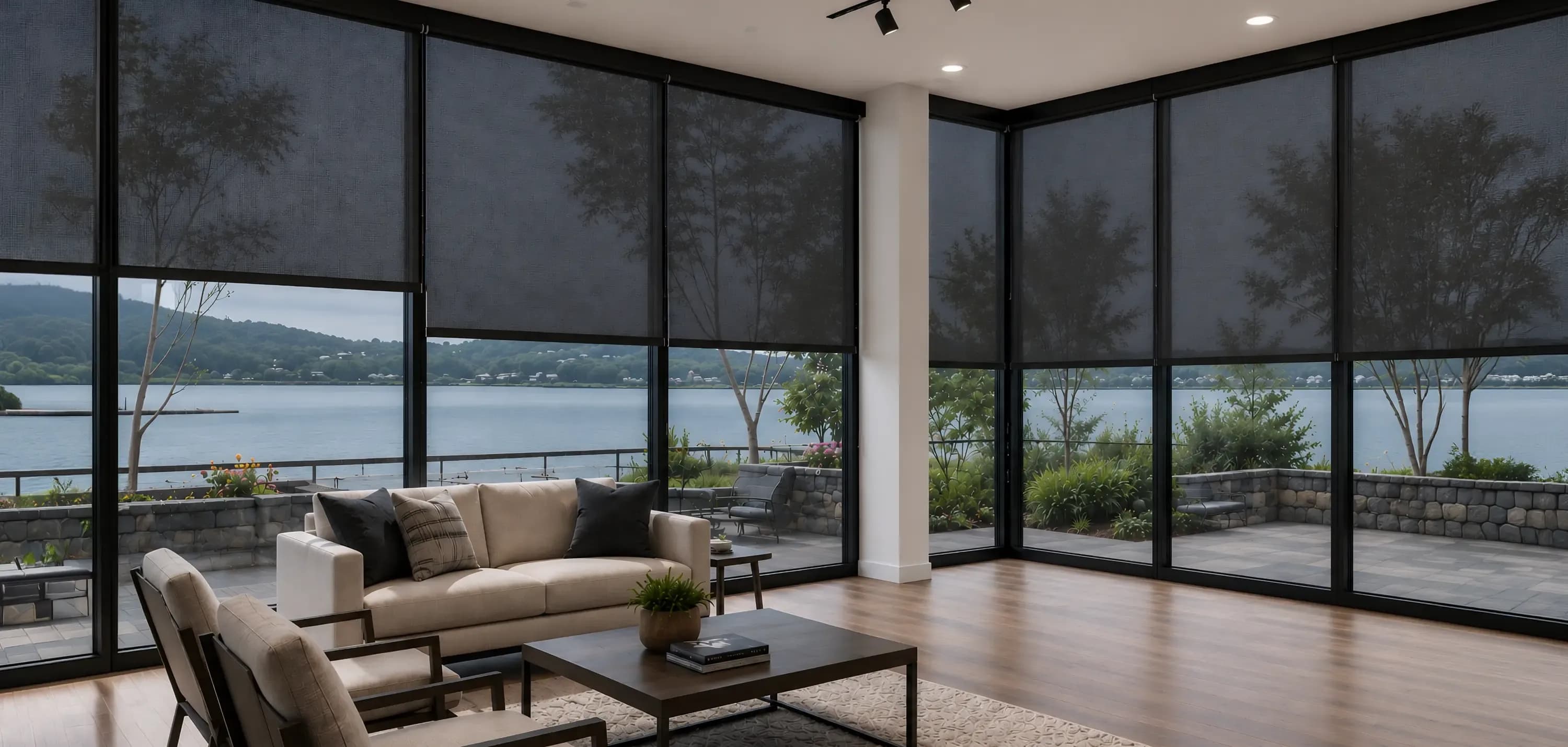
Roller shades offer the cleanest, most minimal aesthetic of any shade category, with the widest fabric selection — from solar mesh to blackout — and seamless motorization. They're suitable for most modern new constructions because they work for contemporary, transitional, coastal, and minimalist interiors equally well, with no visible hardware when cassette-housed.
Yes. Blackout roller shades block 99–100% of light through the fabric. For near-total darkness, specify an outside-mount installation with side-channel tracks to eliminate edge gaps, or add a cassette housing to seal the top. When paired with blackout drapery, they ensure a true darkroom environment.
Yes — solar roller shades with 1–3% openness block 95–99% of UV and reduce solar heat gain by 80–99%, while preserving your outdoor view. Choose 1–3% openness for intense west and south exposures, and 5–10% for east and north windows where view preservation matters more. ENERGY STAR research estimates they can cut cooling energy use by 10–20% on high-sun exposures.
For windows you use daily — bedrooms, media rooms, tall windows, and wide openings — motorization is absolutely worth it. Sunrise scheduling, one-tap blackout, and hands-free operation make a genuine daily difference. Our Gamana Tech motors integrate natively with Amazon Alexa, Google Home, Apple HomeKit, Samsung SmartThings, Control4, Crestron, Savant, and the Matter cross-platform standard, with battery life of 6–12 months and USB-C recharging.
Choose roller shades for the cleanest minimalist look and widest fabric selection — best for bedrooms, offices, and open-concept living areas. Choose banded (zebra) shades if you want adjustable daytime privacy and view-through flexibility without fully raising the shade — ideal for living rooms and urban spaces. Choose cellular shades if energy efficiency is the priority — they insulate at R-2 to R-5 versus roller shades R-1, making them the better choice for temperature-sensitive rooms like bedrooms in hot or cold climates.
Roller shades are among the easiest window treatments to maintain: dust every 1–4 weeks with a microfiber cloth, vacuum-brush every 1–3 months, and spot-clean with a damp cloth and mild soap as needed. Most performance fabrics tolerate damp cleaning. With normal use, custom roller shades last 8–15 years — significantly longer than ready-made alternatives.
Yes. Your consultation is completely free, with no obligation to purchase. It’s an opportunity to discuss your needs, explore suitable window treatment options, and receive expert recommendations for your space.
One of our window treatment specialists will discuss your style preferences, privacy and light control needs, room functionality, and budget. You’ll also be able to explore fabrics, materials, colours, and operating options to find the right solution for your home.
Most consultations take between 45 minutes and an hour, depending on the number of windows and the products you’d like to explore.
No. You don’t need to take any measurements before the consultation. If you decide to move forward, we’ll take precise measurements to ensure a perfect custom fit.
Absolutely. Your consultant will bring a curated selection of fabric, material, and colour samples so you can compare options in your own lighting and décor.
Yes. Whether you’re looking for better privacy, light control, insulation, child-safe options, motorization, or a particular design style, we’ll guide you to the products best suited to your home.
Not at all. Our consultation is designed to help you make an informed decision. You’re welcome to take your time before placing an order.
Yes. Once we understand your requirements and product selections, we’ll provide a detailed quotation based on your custom specifications.
Yes. During your consultation, we can demonstrate available motorized options, explain how they work, and help you choose the right control system for your home.
We provide in-home consultations through our network of local design consultants across the United States. Simply enter your ZIP code or contact us to confirm service availability in your area.free? Yes. Your consultation is completely free, with no obligation to purchase. It’s an opportunity to discuss your needs, explore suitable window treatment options, and receive expert recommendations for your space. between 45 minutes and an hour, depending on the number of windows and the products you’d like to explore.
Our free in-home consultation typically takes 45-60 minutes. We'll measure your windows, discuss your needs, show samples, and provide a detailed quote on the spot.
Cellular shades can reduce heating and cooling costs by 10–25% according to ENERGY STAR estimates, and cut solar heat gain through windows by up to 60% per the U.S. Department of Energy. Savings are biggest on west and south exposures and older windows. In hot climates, certified double-cell shades have been shown to lower window-area temperatures by 8–15°F during peak afternoon hours.
Single-cell delivers R-2.0 to R-2.5 insulation — good for moderate climates. Double-cell stacks two rows of cells for R-3.0 to R-4.0, better noise reduction, and a slimmer raised profile when open. Choose double-cell for bedrooms, hot or cold climates, and any room where energy performance matters most. With side tracks, double-cell blackout reaches R-5.0 — doubling the insulating value of a standard double-pane window.
Very close. Blackout cellular fabrics block 99–100% of light. Add our Gamana Tech LightSeal side-channel tracks and an outside-mount installation to seal edge gaps, and the result approaches true darkroom darkness. Motorize for a gradual 10–20 minute sunrise opening so you wake up naturally without a sudden blast of light.
Top-Down/Bottom-Up shades lower from the top for upper-window light while keeping the lower half closed for eye-level privacy — or raise conventionally from the bottom. They're ideal for street-facing rooms, bathrooms, and bedrooms near neighbors — one of the most practical options for ground-floor privacy.
Yes. Cordless and motorized cellular shades fully meet WCMA 2018 cord-safety standards — the only options the U.S. Consumer Product Safety Commission endorses for households with children under 9. Motorized versions integrate natively with Alexa, Google Home, Apple HomeKit, SmartThings, Control4, Crestron, Savant, and Matter — all controlled from one hub or app.
Yes — they're one of the highest-impact upgrades for sun-heavy homes. Honeycomb cells block heat transfer and can reduce peak window-area temperatures by 8–15°F in climates like Texas, Arizona, and Florida. Single shades cover openings up to 8–10 feet wide; wider openings use coupled shades. Motorization is strongly recommended for any window over 6 feet wide — battery motors need no electrical work and recharge via USB-C every 6–12 months.
Yes, to both. The honeycomb cells absorb sound, typically reducing street noise by 3–6 decibels — more when layered with drapery. On UV, light-filtering fabrics block 50–80%, room-darkening blocks 95–99%, and blackout blocks essentially 100%. Since visible light also causes fading over time, any cellular shade provides meaningful protection for furniture, flooring, and artwork.
Yes. Our Gamana Tech motors come in three tiers: Quiet for near-silent bedroom operation (32–38 dB), Pro Battery for everyday use, and Essential for budget projects. Battery motors require no electrical work, last 6–12 months per charge, and recharge via USB-C — well worth it for bedrooms, tall windows, and grouped shades.
Triple Shades suspend horizontal fabric vanes between two sheer panels, creating soft filtered light with adjustable opacity — think plantation shutter louvers in fabric form. Choose them over roller shades when you want fabric depth and warmth rather than a flat panel. Choose them over banded shades when softness and luxury matter more than sharp contemporary lines. Triple Shades cost more but produce a distinctly richer, more designer light quality that neither roller nor banded shades can replicate.
Yes — effectively. Open the vanes for filtered light and a softened view-through; tilt them to adjust opacity; close them fully for complete privacy. The sheer outer panels diffuse direct sunlight throughout all positions, keeping rooms consistently bright and calm rather than harsh. They're particularly effective on south-facing windows with strong midday light where hard-fabric shades can feel stark.
Yes. Single Triple Shades typically cover openings up to 10–12 feet wide; wider spans use coupled shades operating as one group. For open-concept spaces, coordinated Triple Shades across the main living level add visual richness and consistency without visual clutter. Motorization is strongly recommended for windows over 6 feet wide to keep vane positioning precise and even across multiple shades.
Yes — this is one of their strongest qualities. The layered sheer construction diffuses direct sunlight and cuts harsh glare while the open vane position still allows a softened outward view. For south-facing living rooms and dining rooms where you want natural light without squinting at screens or across the table, Triple Shades deliver better glare control than a single-layer sheer or roller shade while preserving far more light than a solar shade.
They work well for daytime privacy and general light reduction in bedrooms. However, true blackout is not possible — the suspended vane construction leaves minor gaps that prevent 100% darkness. For full bedroom blackout, layer Triple Shades with blackout drapery, or choose blackout cellular shades or blackout roller shades with side tracks instead. Many luxury primary bedrooms use Triple Shades for daytime and layer blackout drapery for nighttime darkness.
Yes. Motorized Triple Shades run on Gamana Tech motors — typically the Quiet line for near-silent premium operation or Pro Battery for everyday use. They integrate natively with Amazon Alexa, Google Home, Apple HomeKit, Samsung SmartThings, Control4, Crestron, Savant, and Matter. Popular scenes include "Morning Light" with vanes open, "Working" with vanes tilted, and "Evening" with vanes fully closed — all controlled by voice, app, or schedule.
Triple Shades and drapery serve different purposes and work best together. Triple Shades handle the technical side — filtered light, daytime privacy, glare reduction. Drapery adds aesthetic scale, softness, additional insulation, and full nighttime privacy. Layering Triple Shades with ripple-fold drapery on a ceiling-mount track is one of the most luxurious window treatment configurations available — common in high-end living rooms and primary bedrooms where both performance and visual richness matter.
Most custom shades are ready for installation within 2–4 weeks after your order is confirmed. Lead times may vary depending on the product, fabric, and customization options you choose.
Every SlickBlinds shade is made to your exact window measurements and selected fabric. This custom manufacturing process ensures a perfect fit, smooth operation, and a finished product that’s built specifically for your home.
Yes. We’ll keep you informed throughout the process, from order confirmation and production to scheduling your installation, so you always know what to expect.
While most orders arrive on schedule, specialty fabrics or custom options can occasionally extend production time. If there’s a delay, we’ll notify you promptly and provide an updated delivery timeline.
As soon as your custom shades arrive and complete our quality check, our team will contact you to schedule installation at a convenient date and time.
If you’re working toward a move-in date or renovation schedule, let us know during your consultation. We’ll recommend products with shorter lead times whenever possible and do our best to accommodate your timeline.
Plantation shutters are premium interior window coverings with wide adjustable louvers mounted inside a custom frame attached to the window casing — closer to built-in cabinetry than a removable shade. Homeowners choose them for five reasons: timeless aesthetic across nearly every interior style, precise light and privacy control through adjustable louvers, modest resale-value contribution, and lower maintenance than fabric shades.
Hardwood (typically basswood) is lighter, takes stains beautifully, and looks more authentic — but costs more and can warp in humidity. Poly (engineered polymer) resists moisture, costs less, and looks nearly identical from a few feet away. Choose hardwood for living rooms, dining rooms, libraries, and primary bedrooms in dry climates. Choose poly for bathrooms, kitchens, laundry rooms, and humid-climate homes. Most whole-home projects mix both — hardwood in primary rooms, poly in wet rooms.
Yes, moderately. Closed louvers create a thermal break, giving hardwood shutters an insulation value of around R-2.7 and poly slightly lower. They reduce solar heat gain by 60–80% depending on louver angle — fully closed louvers block the most. While they don't match cellular shades on pure thermal performance, their adjustability, durability, and light control make them a strong all-around choice, especially in hot climates.
3.5-inch louvers are the most popular current specification — versatile, modern, and suited to most window sizes. For luxury homes or large windows, 4.5-inch louvers create a more dramatic, high-end look with better outward visibility when open. For tilt style, hidden tilt (no exposed center rod) is the most requested modern choice, giving shutters a clean architectural appearance. Traditional exposed tilt rods still suit formal or classic interiors.
Yes. Plantation shutters are available for arches, half-rounds, circles, angled tops, octagons, French doors, bay windows, and sliding doors. For very wide windows, multi-panel configurations (4, 6, or 8 panels) keep proportions clean. Specialty shapes require precise measurement and the right manufacturer program — your consultant confirms feasibility during the in-home visit.
Yes, on both. Real estate professionals consistently cite plantation shutters as a desirable upgrade, and National Association of Realtors survey data shows they can add 1–4% to perceived home value in mid-to-upper-tier homes — often offsetting much of the initial cost at sale. On lifespan, plantation shutters routinely last 20+ years with normal care, making them the longest-lasting interior window treatment available and one of the best long-term investments per year of use.
Four factors shape the investment: material (hardwood costs more than poly), louver size (larger louvers add cost), window complexity (specialty shapes and multi-panel configurations cost more), and finish (stained hardwood costs more than painted). Book a free in-home consultation for a written estimate tailored to your exact windows and material preferences.
Store-bought blinds are available in standard sizes with limited options. Custom Window Blinds are made to your exact window dimensions, offering a better fit, greater customization, and improved performance.
Popular options include Faux Blinds, Faux Wood Blinds, Wood Blinds.
Yes. Faux Wood Blinds offer the appearance of real wood while providing enhanced moisture resistance and durability.
Yes. Adjustable slats allow you to control visibility, privacy, and natural light throughout the day.
No, motorization is not possible with Faux and wood blinds
Faux Blinds and Faux Wood Blinds are often recommended for moisture-prone environments because of their durability and easy maintenance.
Yes. Professional measurements help ensure a precise fit and smooth operation.
Yes. Every project includes expert measurement and professional installation.
Three reasons: precise sizing (correct length, proper fullness, hem at exactly the right height), proper construction (lined, weighted hems, professional finishing), and hardware quality. Ready-made panels are typically a fraction of the cost but look visibly wrong — too short, too flat, or poorly finished. Custom drapery drapes correctly, lasts 10–20 years, and elevates any room in a way off-the-shelf panels simply can't replicate.
Modern: Ripple-fold (soft continuous S-curves on a concealed track) is the most popular current specification — clean, minimal, and elegant. Inverted pleat and grommet styles also suit contemporary interiors. Traditional: Pinch pleat, goblet pleat, and French pleat create structured, formal folds suited to classic and transitional rooms. For most new installations today, ripple-fold on a ceiling-mount concealed track is the go-to luxury choice.
Mount the rod 4–12 inches above the window frame — or at ceiling height in rooms with 8-foot ceilings. Use full-height panels that run floor to ceiling rather than ending at the window frame. Extend the rod 6–12 inches beyond each side of the window so panels stack off the glass when open, exposing maximum glass and making the window appear significantly wider. These three details alone transform how a room feels.
Yes, on all three. Lined and interlined drapery adds R-1 to R-3 of insulation and reduces drafts when panels extend past the window frame to the floor. For noise, heavy lined drapery dampens sound by 5–10 decibels; layered with a shade, you gain another 3–5 decibels. For UV, blackout-lined drapery blocks 95–99% of UV — protecting furniture, flooring, and artwork from fading.
Almost always yes. Unlined drapery hangs poorly, fades faster, and looks flat. Your three options: Lined — fabric plus a separate lining layer; drapes well, blocks more light, lasts longer. Interlined — adds a third middle layer for the most luxurious drape, best insulation, and strongest acoustic absorption. Unlined — lightest and most casual; only appropriate for informal spaces or sheer drapery where transparency is the intent. For most installations, lined is the minimum; interlined for primary bedrooms and formal rooms.
Yes. Our Gamana Tech Drapery motor line covers traverse, center-open, single-open, and pinch-pleat configurations. Three tiers are available: Drapery Quiet for near-silent premium operation, Drapery Pro for everyday use, and Drapic Essential for entry-level projects. All integrate natively with Alexa, Google Home, Apple HomeKit, SmartThings, Control4, Crestron, Savant, and Matter.
Everything. Your local design consultant brings physical fabric samples to your home, evaluates rod height, projection, and panel sizing for your specific windows, and produces a written estimate. Professional installation covers rod or track mounting, panel hanging, hem adjustment, and motorized system programming if applicable. Warranty service is handled locally — no shipping panels to a factory or waiting on a call center.
For wide openings, sliding glass doors, primary bedrooms, and any drapery operated daily — yes. Manually pulling heavy drapery panels across an 8-foot or wider opening becomes tedious quickly. Motorized operation is smooth, silent, and controllable by remote, app, or voice. It's also the most popular fast-growing category in our lineup, particularly on great-room openings and primary bedrooms where one-tap open and close routines make a genuine daily difference.
Four factors shape the investment: fabric tier (basic to designer collections), fullness (luxury installations use 2.5× to 3× fabric width), construction (unlined, lined, or interlined each add performance and cost), and header style (ripple-fold on a motorized track costs more than a simple rod-pocket). Book a free in-home consultation for a written estimate tailored to your exact windows and design preferences.
Roman shades combine soft fabric warmth with the clean simplicity of a shade. They stack into neat horizontal folds when raised, suit more interior styles than almost any other product, and add a polished, designer look that flat roller shades can't replicate. They're the top choice for bedrooms, dining rooms, and formal spaces where texture and warmth matter.
Flat-fold. A smooth panel when lowered with clean folds only when raised, it reads as contemporary and architectural. Hobbled suits transitional interiors, relaxed suits coastal and farmhouse, and balloon is traditional. For modern homes, flat-fold in a neutral linen or performance fabric with outside-mount installation is the current standard.
Close. Blackout-lined Roman shades block 99–100% of light through the fabric. Outside-mount installation or side-channel tracks seal edge gaps for near-complete darkness. For maximum blackout, layer with blackout drapery. For pure darkness performance, blackout cellular shades with side tracks edge slightly ahead.
Roman shades support the widest fabric range of any shade — linen, hopsack, performance bouclé, woven natural fibers, designer drapery weights, blackout constructions, and silk. Premium options come from the Vara Natural Weave, Vara Curated Designer, and Vara Drapery Collection. Blackout and interlining options are available across most fabric choices.
Yes, with one caveat. Single shades work up to 8–10 feet wide; wider openings use multiple shades side by side. For tall or wide windows, motorization is strongly recommended — large Roman shades become very heavy to operate manually. It's especially worthwhile on primary bedroom windows and any opening over 6 feet wide.
Yes. Cordless and motorized Roman shades fully meet WCMA 2018 cord-safety standards — the only options endorsed for households with children under 9. Motorized versions integrate natively with Alexa, Google Home, Apple HomeKit, SmartThings, Control4, Crestron, Savant, and Matter. For nurseries, cordless or motorized blackout-lined Roman shades in cleanable performance fabrics are the recommended specification.
Yes. Every motorized Roman shade runs on Gamana Tech motors — the Quiet line for bedrooms, Pro Battery for general use. Battery motors need no electrical work, last 6–12 months per charge, and recharge via USB-C. Schedule, group, and control shades through the Gamana Tech app or any connected smart-home platform.
Banded shades feature alternating horizontal bands of solid and sheer fabric on a single roller. Slide the bands to align for a clear view-through, or stagger them for privacy with diffused light — one product, multiple light scenarios. Choose banded over standard roller shades when you want adjustable daytime privacy and view flexibility throughout the day. Roller shades offer a cleaner single-fabric look; banded shades give you more control without raising the shade completely.
Yes — this is their primary strength. When solid and sheer bands are staggered, banded shades deliver diffused daytime privacy while still admitting significant natural light. Align the bands for a fully open view-through, or stagger them for a softly lit, private room. They're especially popular in living rooms, dining rooms, urban condos, and homes close to neighbors where light and privacy needs shift through the day.
Yes, on both counts. Single banded shades typically fit windows up to 10–12 feet wide; for wider openings, coupled shades operate as one group. For open-concept homes, coordinated motorized banded shades across the main living level maintain a consistent modern look while allowing different alignment settings room by room — one of their strongest use cases. Motorization is strongly recommended for windows over 6 feet wide to keep band alignment precise and even.
Not fully. Room-darkening banded shades exist but the alternating band construction has minor light gaps at the band joints that prevent true blackout. For bedrooms requiring complete darkness, blackout roller shades or blackout cellular shades with side-channel tracks are the better choice. Banded shades work well in primary bedrooms for daytime privacy and general light reduction, especially when layered with blackout drapery for full nighttime darkness.
Yes, moderately. When bands are staggered for opacity, banded shades reduce glare and direct solar heat gain meaningfully. For glare control on TVs and monitors, the staggered position cuts harsh reflections while preserving ambient light — making them a practical choice for living rooms and home offices. For energy efficiency, they perform comparably to single-layer roller shades. If heat reduction is the primary goal, cellular shades or exterior solar shades outperform banded shades.
Yes — motorized banded shades are actually the most common configuration, especially on wider windows. Our Gamana Tech motors integrate natively with Amazon Alexa, Google Home, Apple HomeKit, Samsung SmartThings, Control4, Crestron, Savant, and the Matter cross-platform standard. Popular smart-home scenes include "Morning" (bands aligned, full light), "Working" (bands staggered, diffused light), and "Evening" (bands fully closed for privacy). A single Gamana Tech hub controls every motorized shade in the home — no separate apps needed.
Everything is included in the price. A local design consultant brings physical fabric samples to your home, measures down to a 1/8-inch tolerance at three points per window, and produces a written estimate on the spot. After manufacturing (typically 2–4 weeks for banded shades), a certified installer mounts, levels, and programs every shade on-site — including smart-home pairing for motorized systems. Warranty service runs through your local dealer, not a national call center, meaning most issues are resolved within 2–4 weeks. If our installer mismeasures, the remake is entirely on us.
Five factors shape the investment: window size, fabric tier, motorization, cassette housing, and installation complexity. For whole-home projects, starting with high-impact rooms — west-facing spaces or primary bedrooms — and phasing remaining rooms over time is a practical approach. Book a free in-home consultation for a written estimate tailored to your exact windows and needs.